In the past few years, Luxembourg has swapped the #1 'Richest Country' spot with Ireland, but the gap is currently undeniable. Financially, Luxembourg's strengths rest in its financing expertise, its location in central Europe, and its varied economy. Nearly half of Luxembourg's workforce commutes from neighboring countries each day. Although these commuters contribute to the country's GDP, they do not reside in Luxembourg. Approximately 130 banking institutions have made themselves at home in Luxembourg, and by nature, this means that the global cash flow is a constant boon.
Second, Luxembourg is also the second-biggest country (after the United States) for managing investment funds, handling around 5 trillion USD. This capital means the government, as well as private institutions, can throw their full weight at lucrative fields like technology and data industries.
2. Ireland - $133,895
Dublin, Ireland, Night view of the famous illuminated Ha Penny Bridge in Dublin, Ireland, at sunset
Population: 5,304,000
GNI per capita: $79,730
Total GDP: $564.02 billion
Although Ireland has dipped farther behind Luxembourg due to a recession caused by low pharmaceutical exports and weakened manufacturing enterprises, it is still a behemoth of financial power in 2024. Ireland's momentum, historically, has only been aided by its 12.5% corporate tax rate, one of the world's lowest. This tax policy mixes well with its skilled, English-speaking workforce, and multinationals like Google and Apple are thus driven to make Ireland their European base.
Furthermore, Ireland's pro-globalization economic policies have further encouraged foreign direct investment (FDI), which ultimately enriches citizens who benefit from increased commercial activity. Additionally, like many of the European countries on this list, Ireland's involvement in the European Union grants it membership privileges and subsidies that go far under shrewd budget policies, which Ireland has.
3. Singapore - $133,737
Aerial view of Singapore City on a sunny day
Population: 5,997,000
GNI per capita: $67,200
Total GDP: $525.23 billion
Singapore's list of techniques for drawing in riches is similar to Ireland's—low corporate tax rates, light regulations, a strategically located port—but the history is exceptional. Lee Kuan Yew, Singapore's prime minister from 1959 to 1990, is considered the father of the city-sized country because he leaned into the shared values of the region's ethnic groups and invested obsessively in private banking, shipbuilding, and electronics. The gamble clearly paid off, and today, progressives laud the government for its unrelenting provision of social services like housing and healthcare.
4. Qatar - $112,282
The Bay of Doha in Qatar
Population: 2,986,000
GNI per capita: $70,120
Total GDP: $244.69 billion
Oil and natural gas are the currencies of choice that brought financial acclaim to Qatar's doorstep, and considering the country possesses more than 15% of all proven gas reserves in the world, that dominance is unlikely to be unseated in the near future. Those lustrous funds have been shoveled toward cutting-edge technology, architecture and engineering, and cultural extravaganzas like the 2022 FIFA World Cup. Glamour aside, Qatar has also been meticulous with investing its riches as if it were a hedge fund, and so now it paces ahead of other oil nations.
5. United Arab Emirates - $96,845
Skyline of Dubai in the UAE
Population: 9,257,000
GNI per capita: $49,160
Total GDP: $527.80 billion
The United Arab Emirates is one of the world's most iconic countries due to its fantastical income, which stems from its operations in global business as well as revenues from natural gas. This two-pronged approach of both services and production has served the country well, enough to fund Lamborghini police units and cloud seeding technology that causes rain to fall artificially (sometimes Dubai even floods, such as it did in April of this year).
Speaking of aquatics, the Dubai harbor is excellently positioned between Europe, Africa, and Asia; Jebel Ali is considered one of the busiest ports in all of the Middle East and Africa. Roughly 212 people live in Dubai with a net worth of above $100 million, and there are an additional 15 that are counted as billionaires.
6. Switzerland - $91,931
Basel, Switzerland. Old town with red stone Munster cathedral on the Rhine river
Population: 8,932,000
GNI per capita: $95,490
Total GDP: $938.46 billion
A financial growth chart of Switzerland, when held up to the horizon, might be indistinguashable from the ever-climbing alps the region is famous for. Switzerland ranks sixth because it prides itself on its own industriess, investing heavily into gems, chemicals, and machine manufacturing goods that find their way across the European Union and the world.
Additionally, services are no small part of the country's value, which include the ever-reliable realms of banking, tourism, and insurance. If broken down, approximately 74% of the Swiss GDP is related to these services, and the rest, the aforementioned manufacturing industry. Agriculture is the one domain that Switzerland is not globally renowned for, although Swiss farmers do produce a little over half the food that is consumed within Switzerland, so self-reliance is still a clear priority.
7. San Marino - $86,989
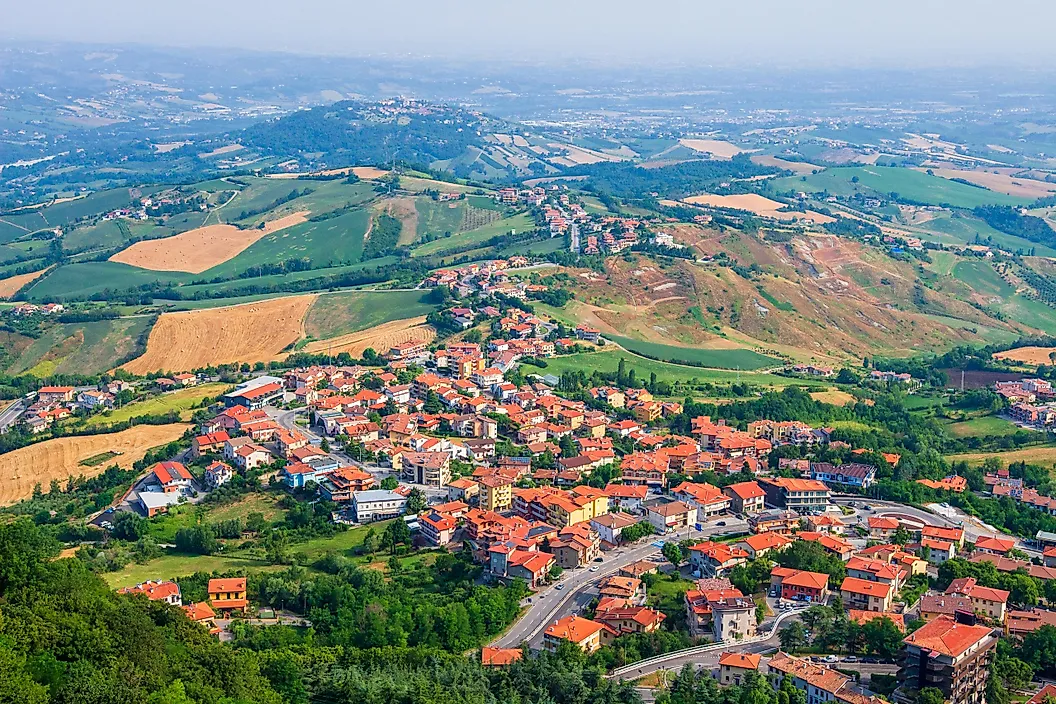
View on San Marino city from observation deck
Population: 35,200
GNI per capita: $47,120
Total GDP: $2.03 billion
San Marino is almost identical to Switzerland in terms of its source of income: services and manufacturing (ceramics, clothing, paints, wine, to name a few) are time-honored pillars of financial well-being. Tourism appeal is slightly different, however, because visitors typically come to bask in the local Mediterranean climate during cold seasons elsewhere. The poverty rates in San Marino are among the lowest on the planet, which is likely related to its stance on transparent taxation. Merchant banking was this microstate's strong suit in ages past, so the country's networks and ancestral talents have been lying in wait for the trade networks and industrialization of the past century— this advantage cannot be understated.
8. United States - $85,372
New York City Financial District cityscape at dusk
Population: 341,963,000
GNI per capita: $76,770
Total GDP: $28.78 trillion
The "New World" came with more than just tomatoes for sauce and corn for cob; in the stretches of land that became known as the United States, untapped veins of gold, silver, and hydrocarbons were, and still are, practically limitless. The security of being isolated from the rest of the world has also aided the United States, allowing it to invest in specialist industries like biotechnology, engineering, and computer technology.
All in all, the United States has a larger GDP than any other country on the planet. However, its high population of 340 million residents means that there are a lot of mouths to feed, economically speaking. One advantage the United States wields is its imposing military, which has granted it significant weight in global negotiations with Japan, specifically, because Japan was barred from operating a military following World War II.
9. Norway - $82,831
Aerial view of Oslo the capital of Norway
Population: 5,578,000
GNI per capita: $94,540
Total GDP: $526.95 billion
The Ocean gives, and the Ocean takes, but Norway takes more. Seafood is one backbone of the Norwegian economy, alongside energy exports, and experts maintain that these ocean-based industries are responsible for 40% of Norway's value creation. Regarding individual experience, Norway's sleek legal system and protections of property rights, as well as an innovative commercial environment, have landed the country in 10th-place of the world's freest economies, according to the Heritage Economic Freedom Profile.
The standard of living in Norway is famously high, and the currency (the Norwegian 'Kroner') stands independent and proud in the global economy. In USD, the average minimum wage in Norway is roughly $22.00/hour, and for comparison, the minimum wage in the USA can drop as low as $7.25/hour.
10. Guyana -
Downtown Stabroek Market at night - Georgetown, Guyana
Population: 741,300
GNI per capita: $14,920
Total GDP: $21.18 billion
Guyana is the Dark Horse of the richest countries this year. Oil production began as recently as 2019, and that industry skyrocketed the South American country into the major leagues. The country is largely English-speaking due to its British colonial past, and Georgetown reigns as its capital. The acceleration of its economy, described as a "double-digit growth" by worldbank.org, occurred in 2023 when additional oil fields began operating. However, one threat to Guyana's stability appears in the tensions building up between it and Venezuela; Venezuela appears to be testing waters over a long-standing territorial dispute around the Essequibo region.




.jpg)
Comments
Post a Comment